


What Is a Space Capsule House — and Why Is Everyone Talking About Them?
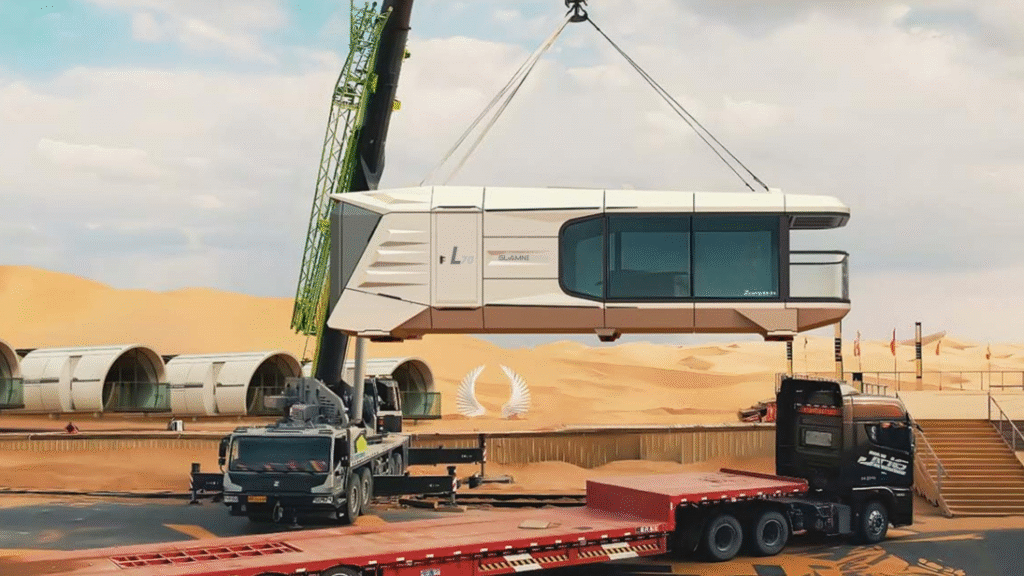
A space capsule house is a factory-built, aerospace-grade aluminum prefab home designed for long-term living, vacation rental, or full-scale commercial hospitality. Unlike conventional construction, every unit is completed entirely in the factory — walls, insulation, plumbing, electrical, interior finishes — then crane-lifted onto your site. From delivery to move-in can be a matter of days.
Since 2020, space capsule prefab container homes have taken off across high-end glamping sites, lakefront resorts, alpine retreats, and coastal hotels worldwide. The reason is simple: no other prefab building form delivers sci-fi visual impact, ultra-short build timelines, and near-zero long-term maintenance costs in a single package.
Four reasons global buyers are making the switch:
They go viral on their own. The sleek, futuristic aluminum shell is a natural magnet on Instagram and TikTok. Guests photograph and share without any prompting — that’s free marketing that traditional log cabins and shipping container homes simply can’t replicate.
They get you open faster. Factory prefabrication means the only on-site work is hooking up utilities. You’re generating revenue 3 to 6 months sooner than a conventional build.
No permanent foundation required. That flexibility is critical for tourism land leases, short-term rental plots, or any site where permanent construction is restricted or impractical.
The math works. Premium space capsule units command nightly rates of $200 to $800. With a predictable cost basis and fast deployment, the ROI window is typically 1 to 3 years.
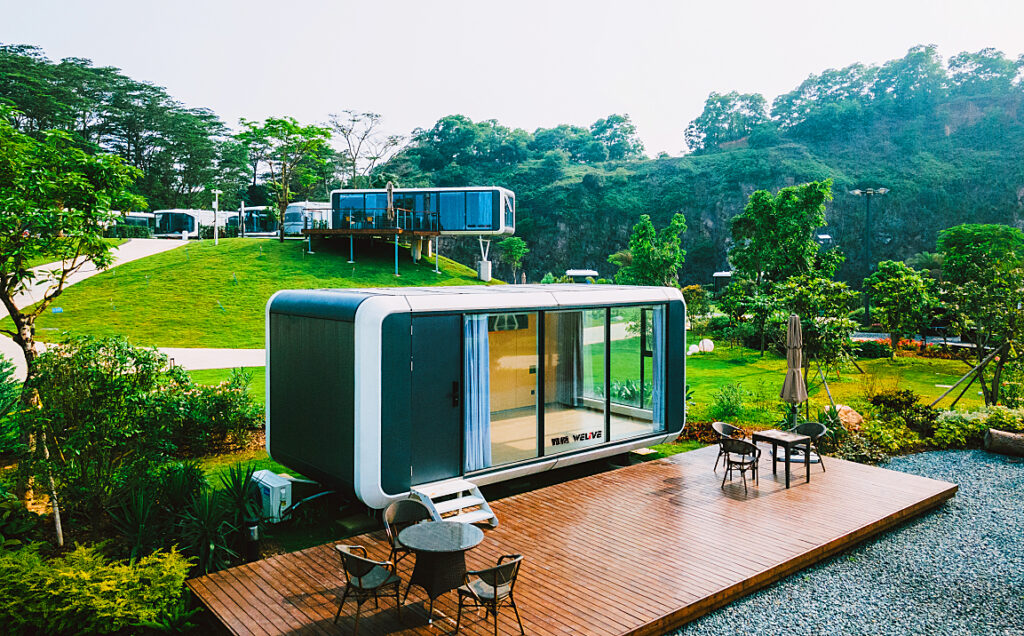
Structure & Materials: What Are You Actually Buying?
First-time buyers almost always ask the same three questions: What’s the shell made of? Is the insulation actually good? How long will it last? These aren’t just spec-sheet details — they determine the long-term value of your investment.
The Outer Shell
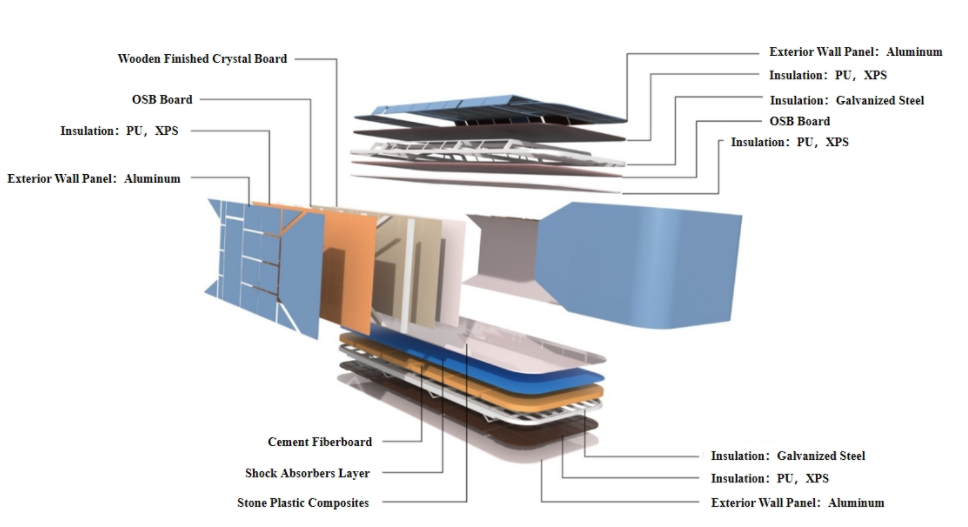
CGCH capsule homes use aerospace-grade 3-series aluminum alloy panels — the same material class found in high-speed rail cars, airport terminals, and skyscraper curtain walls. The surface finish is a PVDF fluorocarbon coating (liquid-applied, not powder-coated), which holds up significantly better against UV degradation, abrasion, and color fade than standard finishes. It performs reliably in tropical heat, Arctic cold, and high-humidity coastal environments. Main frame thickness: 3–4 mm. Panel thickness: 2 mm. Warranty: 30 years on both.
Insulation System
The core insulation is spray-applied polyurethane (PU) foam at 75–100 mm standard thickness, upgradeable to 200 mm for extreme-cold deployments. Most models come standard with triple-pane glazing; double-pane is available on select configurations. Underfloor heating is standard on premium models and optional on others.
Structural Integrity
Full skeletal welding delivers wind resistance rated to Level 9. Every unit undergoes a 100% spray test before leaving the factory — simulating heavy rain and storm conditions with zero leaks. The structure is also engineered to survive long-haul ocean freight without damage.
Electrical & Plumbing
CGCH configures electrical systems to your local voltage standard at no extra charge. Outlet types are customized to your specs — just send a diagram. Plumbing includes pre-installed supply and drain connections ready for on-site hookup. Ventilation runs three layers deep: fresh-air mechanical system, bathroom exhaust fan, and operable windows.
Space Capsule vs Shipping Container Home vs. Log Cabin: Which One Is Right for You?
These are the three most common prefab alternatives buyers compare. Choose the wrong one and the cost is significant — in time, money, and missed revenue.
| Feature | Space Capsule | Shipping Container Home | Log / Light Steel Cabin |
| Visual Appeal | Futuristic, viral-ready | Industrial modern | Rustic / natural |
| Build Speed | Fastest — crane & connect | Fast | Slow (3–12 months on-site) |
| Insulation | Excellent (PU foam + triple glass) | Medium to good | Medium to good |
| 30-Year Maintenance | Very low (aluminum doesn’t rot) | Low to medium | Medium (periodic treatment required) |
| Relocatability | High — move the whole unit | Medium | Near impossible |
| Coastal Salt Corrosion | Excellent (aviation aluminum) | Fair (steel needs treatment) | Poor (wood rots) |
| Social Media Impact | Extremely high | Average | Average |
| All-In Unit Cost | $15,000–$45,000 | $1,500–$20,000 | $20,000–$60,000+ |
The bottom line: If your goal is premium nightly rates, fast deployment, low ongoing costs, and a product that markets itself — the space capsule wins on every axis. If budget is the primary constraint and visual impact isn’t a priority, a new custom-built prefab shipping container home is the next-best value. Log cabins suit projects that prioritize a natural aesthetic when build timelines don’t matter.
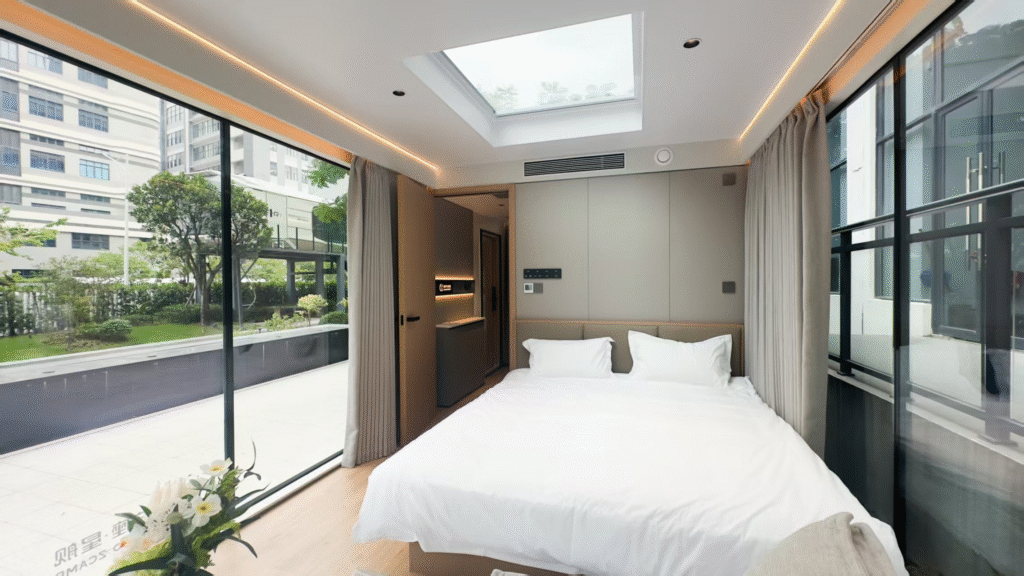
2026 Price List
CGCH models fall into two categories: Assembled (factory-finished, crane-set on arrival) and Disassembled (flat-pack for 40HQ standard container shipping, with significant freight savings).
Assembled Models — Arrive Ready to Use
Requires 40FR flat-rack shipping container. Bulk pricing typically applies to orders of 10+ units.
| Model | Dimensions (m) | Area | Standard Price | Bulk Price | Best For |
| A3 | 5.6×2.8×3.1 | 15.7 m² | $12,000 | $11,000 | Solo/couple starter |
| A5 | 9.5×3.3×3.3 | 31.4 m² | $18,400 | $16,900 | Standard 2-bed suite |
| A7 | 11.5×3.3×3.3 | 38 m² | $22,700 | $20,800 | Family / luxury suite |
| A9 | 13.5×3.3×3.3 | 44.6 m² | $26,500 | $24,300 | XL family suite |
| F7 | 11.5×3.3×3.3 | 38 m² | $23,400 | $21,400 | Signature design |
| H5 | 9.1×3.3×3.4 | 30 m² | $20,700 | $18,900 | Mid-size resort |
| R5 | 9.1×3.3×3.4 | 30 m² | $20,700 | $19,000 | Mid-size resort |
| R7 | 11.5×3.3×3.4 | 38 m² | $24,400 | $22,400 | Luxury resort suite |
| P5 | 9.5×3.3×3.2 | 31.4 m² | $22,100 | $20,300 | Business / boutique B&B |
| P7 | 11.5×3.3×3.3 | 38 m² | $26,100 | $23,900 | Premium resort suite |
| Z5 | 9.5×3.3×3.2 | 31.4 m² | $21,800 | $20,000 | Standard resort unit |
| Z7 | 11.5×3.3×3.2 | 38 m² | $26,900 | $24,600 | Luxury resort unit |
| K3-II | 5.6×2.6×3.2 | 14.6 m² | $12,700 | $11,700 | Compact entry-level |
| K5-II | 8.5×3.2×3.2 | 27.2 m² | $17,800 | $16,300 | Mid-size standard |
| K6-II | 8.5×3.2×3.2 | 27.2 m² | $18,800 | $16,800 | Mid-size upgraded |
| K7-II | 11.5×3.2×3.2 | 36.8 m² | $24,200 | $22,200 | Large standard |
| W3 | 5.6×3.4×3.4 | 19.1 m² | $16,300 | $13,800 | Full-glass view cabin |
| W6 | 9.5×3.4×3.4 | 32.3 m² | $24,200 | $22,250 | Mid-size panoramic |
| W9 | 11.5×3.4×3.4 | 39.1 m² | $30,900 | $28,300 | Flagship panoramic |
| WA7 | 11.5×3.3×3.3 | 38 m² | $26,100 | $23,900 | Large view suite |
| WA9 | 13.5×3.3×3.3 | 44.6 m² | $29,600 | $27,100 | XL panoramic flagship |
Disassembled (Flat-Pack) Models — Lower Freight Costs
Ships in standard 40HQ high-cube containers. No crane or forklift required for assembly. 40HQ capacity: 2 units (23 m²) / 1.5 units (31 m²) / 1 unit (40 m²).
| Model | Dimensions (m) | Area | Standard Price | Bulk Price |
| AE23-A | 6.5×3.48×3.3 | 23 m² | $21,600 | $19,800 |
| AE31-A | 8.94×3.48×3.3 | 31.1 m² | $29,500 | $27,000 |
| AE31-B | 8.94×3.48×3.3 | 31.1 m² | $29,500 | $27,000 |
| AE40-A | 11.38×3.48×3.3 | 40 m² | $37,800 | $34,300 |
| AE40-B | 11.38×3.48×3.3 | 40 m² | $37,800 | $34,300 |
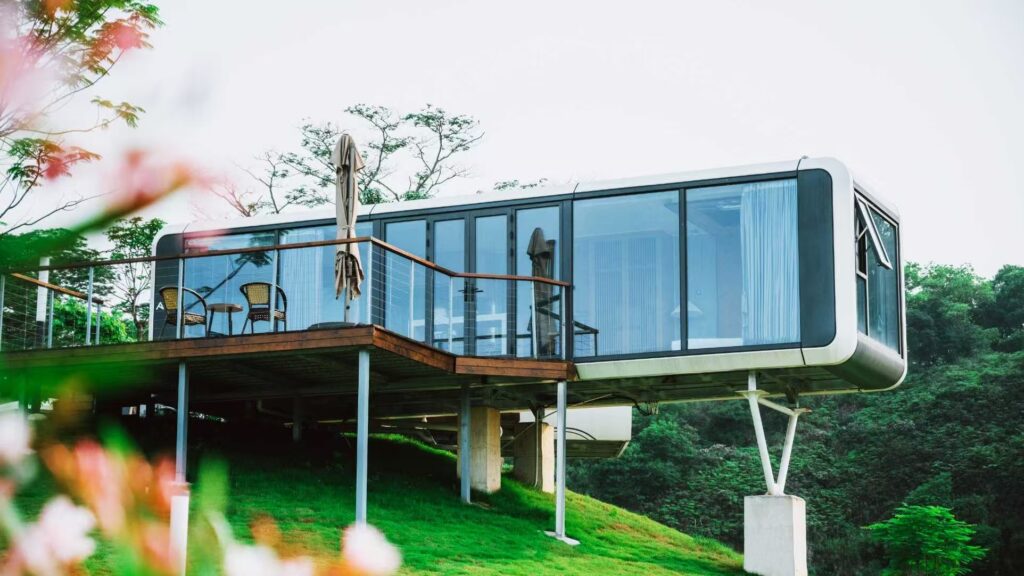
8 Questions You Must Ask Before You Buy
1. What’s the local voltage and outlet standard? Tell CGCH your local electrical specifications upfront. The factory will configure compatible outlets and converters at no additional charge — standard, not a custom add-on.
2. Assembled or flat-pack — which saves more money? Assembled units arrive ready to crane into position. Flat-pack models ship in standard 40HQ high-cube containers, cutting freight costs significantly. The right call depends on your local labor rates versus shipping costs. In markets where freight is expensive and labor is affordable, flat-pack usually wins.
3. Who handles the foundation? CGCH provides standard foundation drawings. You arrange local construction — it’s straightforward and doesn’t require specialized contractors.
4. What certifications does it carry? CGCH holds both CE and ISO certification. If your destination country requires additional local certification, CGCH provides technical documentation and support to help you complete that process.
5. Is OEM / custom branding available? Yes. CGCH supports full OEM branding — your logo, custom exterior colors, and interior design packages. Complex custom work may carry an additional quote.
6. What are the payment terms? Standard terms: 50% TT deposit upfront, balance due before shipment.
7. Do I need professional installers on-site? For assembled units: no. Once craned into position, your crew connects the utilities. For flat-pack units, CGCH provides step-by-step installation videos and live remote guidance. Orders of 10+ units can request on-site engineer support (buyer covers travel costs).
8. What does the warranty actually cover? 30-year warranty on aluminum panels and structural frame. 1-year warranty on appliances and electrical components. Replacement parts for non-damage issues are available long-term — CGCH maintains ongoing parts availability.
Who’s Actually Using Space Capsule Homes?
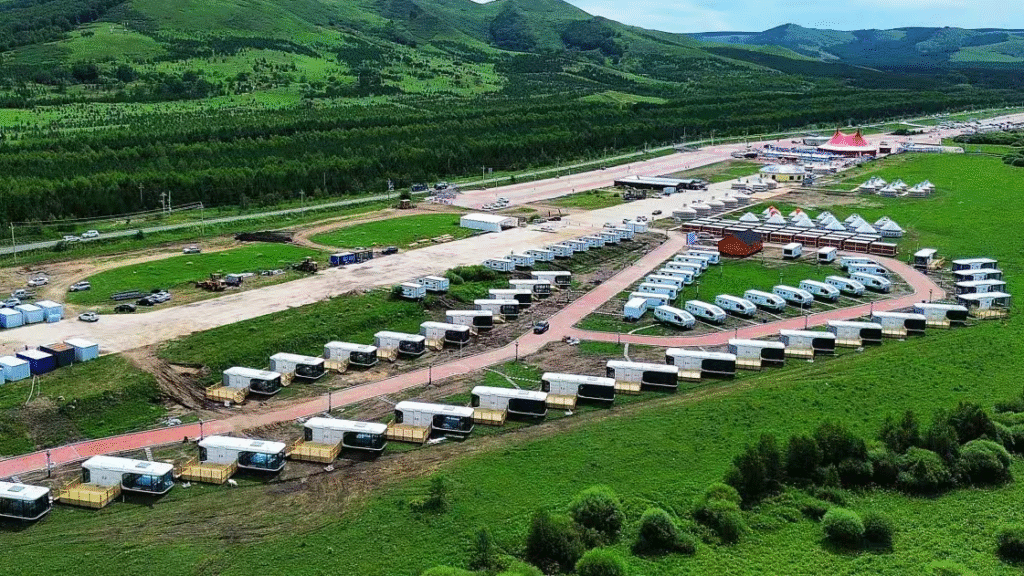
High-End Glamping Operators. The futuristic profile is a social media magnet. Guests post without being asked — your marketing spend goes down while occupancy climbs. CGCH units are currently operating in Indonesia, the Philippines, Poland, Georgia, Russia, and beyond.
Island and Coastal Resorts. Aviation-grade aluminum doesn’t corrode near saltwater. Wiring runs through protected conduit, resistant to moisture and salt spray. Built for year-round operation in high-humidity coastal environments.
Mountain and Ski Resorts. Triple-pane glass plus PU foam plus optional underfloor heating means these units operate comfortably through sub-zero winters. One product, two revenue seasons.
Peri-Urban Family Glamping. The entry-level A3 starts at $12,000 for 15.7 m² — a low-risk way for smaller operators to test the market before scaling.
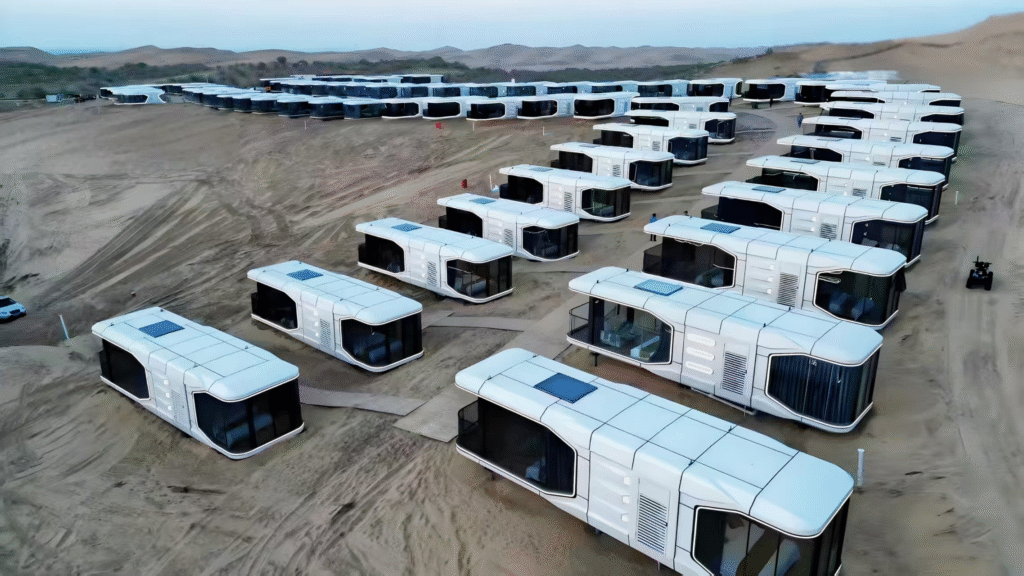
Energy and Mining Camp Operators. This is one of the largest B2B applications for prefab container homes. CGCH has delivered 523 extreme-cold units to Siberian oil fields, 2,000 units for the Qatar World Cup, and 7,812 units to Russia’s Alabuga Industrial Park. Projects at this scale are the ultimate stress test of a manufacturer’s real production capacity and quality control.
International Distributors and Resellers. Full OEM support, co-branded marketing materials, and volume discounts starting at 10 units. Standard dealer onboarding requires a $10,000 deposit or initial purchase of 10 units. Exclusive territory arrangements are negotiated separately.
Who’s Actually Using Space Capsule Homes?
High-End Glamping Operators. The futuristic profile is a social media magnet. Guests post without being asked — your marketing spend goes down while occupancy climbs. CGCH units are currently operating in Indonesia, the Philippines, Poland, Georgia, Russia, and beyond.
Island and Coastal Resorts. Aviation-grade aluminum doesn’t corrode near saltwater. Wiring runs through protected conduit, resistant to moisture and salt spray. Built for year-round operation in high-humidity coastal environments.
Mountain and Ski Resorts. Triple-pane glass plus PU foam plus optional underfloor heating means these units operate comfortably through sub-zero winters. One product, two revenue seasons.
Peri-Urban Family Glamping. The entry-level A3 starts at $12,000 for 15.7 m² — a low-risk way for smaller operators to test the market before scaling.
Energy and Mining Camp Operators. This is one of the largest B2B applications for prefab container homes. CGCH has delivered 523 extreme-cold units to Siberian oil fields, 2,000 units for the Qatar World Cup, and 7,812 units to Russia’s Alabuga Industrial Park. Projects at this scale are the ultimate stress test of a manufacturer’s real production capacity and quality control.
International Distributors and Resellers. Full OEM support, co-branded marketing materials, and volume discounts starting at 10 units. Standard dealer onboarding requires a $10,000 deposit or initial purchase of 10 units. Exclusive territory arrangements are negotiated separately.
How to Spot a Reliable Manufacturer — and Avoid the Rest
Search “space capsule house” or “prefab shipping container home” online and you’ll find hundreds of listings. A significant portion are copycat workshops with no original R&D — they imitate the look of top-tier manufacturers but use thinner aluminum panels, lighter frames, and off-brand appliances. They photograph fine. In practice, you’ll see warping, fading, and leaks within a few years.
Here’s what to verify before you wire a deposit:
Factory scale and operating history. Legitimate manufacturers run large, purpose-built production facilities. CGCH was founded in 2009 and began producing space capsule homes in 2020 — among the earliest entrants in the market. Four factory locations (Guangdong, Anhui, Shanghai, Saudi Arabia) totaling 500,000 m², with monthly output exceeding 300 units.
Large-project delivery record. Small shops can’t execute big orders — and big orders expose every quality control weakness. CGCH has completed the Qatar World Cup (2,000 units), Russia’s Alabuga Industrial Park (7,812 units), and multiple other large-scale energy and industrial projects.
Vertically integrated supply chain. Shops that outsource aluminum panels, flooring, and windows have no real control over material consistency. CGCH’s core materials are manufactured within the group — quality is managed at the source.
In-house design and R&D. Can they actually do custom work, or just copy existing models? CGCH employs 30+ dedicated designers and releases new product lines annually.
Certifications and a real warranty. Look for CE and ISO in writing. Demand a 30-year structural warranty. Low-cost workshops typically cannot back either commitment.
Verified export track record. Ask for real shipment history across multiple countries. CGCH has active exports to Indonesia, Russia, the Philippines, the U.S., Poland, Germany, and others. A physical showroom in Poland is available for in-person visits.
FAQ
What’s the price range for a CGCH space capsule prefab container home? Factory pricing in 2026 runs from $12,000 (A3, 15.7 m²) to $37,800 (AE40 series, 40 m²). Bulk pricing starts at $11,000 per unit. Contact the CGCH sales team to confirm current volume thresholds.
How long from order to delivery? Production takes approximately 40 business days after deposit. Ocean freight to most destinations adds 30–40 days. Plan for 2 to 3 months total from purchase order to unit on-site.
Do these units carry CE certification? Yes. CGCH holds CE and ISO certification. For countries requiring additional local certification, CGCH provides the necessary technical documentation and process support.
Can these homes handle extreme cold? Absolutely. Standard: 75–100 mm PU foam + triple-pane glazing. Extreme-cold spec: 200 mm walls + dual heating backup. Field-verified: 523 units operating in Siberia at -43°C, maintaining 72°F (22°C) interior temperatures throughout winter.
What about desert heat? Desert configurations use 150 mm composite insulation and triple-pane low-E glass. Verified at 46°C (115°F) outdoor temperature — interior holds at 75°F (24°C) with 40% lower AC load than a standard shipping container home.
Will the exterior corrode near the ocean? No. Aviation aluminum passes 3,000-hour salt spray testing. All exterior hardware is 316 marine-grade stainless steel. Base panels carry dual-layer anti-corrosion treatment. Confirmed: zero corrosion after one full year of beachfront operation in Queensland, Australia.
Can I order with my own brand (OEM)? Yes. Full OEM support — custom logos, exterior colors, and interior finish packages. CGCH helps international distributors build their own localized product brand.
Assembled or disassembled — how do I choose? Assembled units crane directly into position — best where local labor is expensive or technical support is limited. Flat-pack units ship in standard 40HQ containers, cutting freight costs — best where shipping is expensive but skilled local labor is affordable. Run the numbers on your regional freight vs. assembly labor costs and the answer becomes clear.
What if my project needs local building permits? CGCH provides structural drawings, material certifications, CE documentation, and technical support letters to assist with local permitting. Factor the documentation lead time into your project timeline.
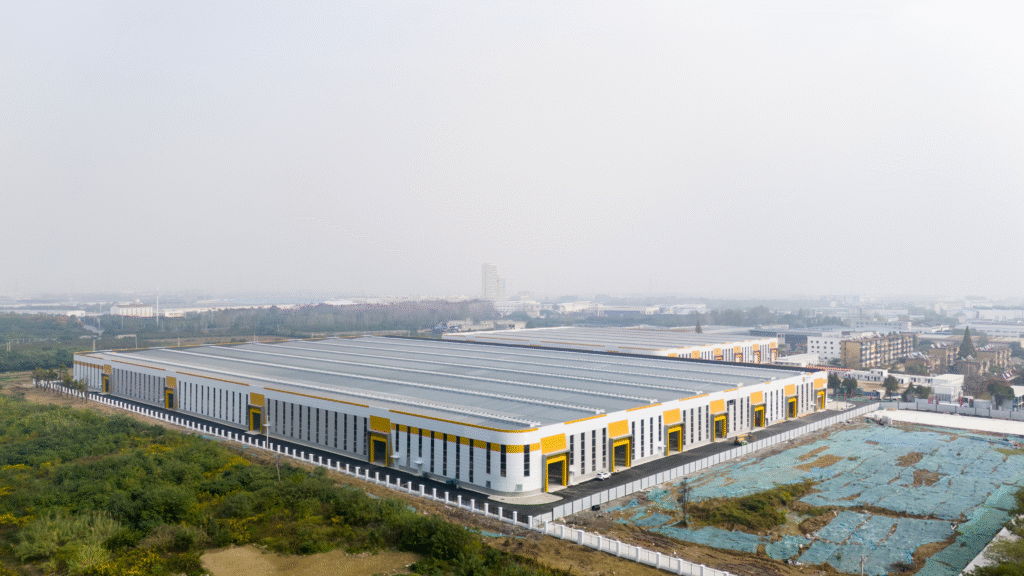
CGCH has been manufacturing prefab modular buildings since 2009. Space capsule homes have been in production since 2020. Export markets include Indonesia, Russia, the Philippines, the United States, Poland, Germany, and others. Physical showroom available in Poland. Contact the CGCH sales team for model recommendations, shipping quotes, and volume pricing.
Email: cgch-ceo@cgchcontainer.com
Website: https://cgchcontainer.com
CGCH — Global One-Stop Modular Camp Delivery Expert